
Kolkata hides more history than its postcards let on, and some of it isn’t hidden at all, just overlooked. Beyond Victoria Memorial and Howrah Bridge, the city holds ten heritage buildings worth a deliberate visit: a 19th century college that shaped the Bengal Renaissance, a 300 year old church tucked inside a wholesale market, the red brick secretariat that once ran an empire, and a graveyard sculpted like a Gothic outdoor museum. This guide covers what each one actually is, why it counts as heritage, when to go, and the nearest metro station, so you can build two easy half day walks without wasting an hour.
📌 Before You Go
- The list splits into two natural loops: North Kolkata/Burrabazar (Metropolitan Institution & the Armenian Church) and BBD Bagh/Esplanade (Currency Building to Bow Barracks). Each loop is a comfortable half day.
(REFER TO THE FAQ SECTION FOR MORE DETAILS) - Carry small denomination cash. Several private residences, churches, and heritage sites don’t take cards, and change is often unavailable at the gate.
- Dress modestly for the Armenian Church, St. John’s Church, and rajbari courtyard, these are active or semi-active religious and family spaces.
- Weekday mornings (10 AM to 1 PM) tend to be quieter than weekends across all ten stops.
In This Article
- 1. Metropolitan Institution, Burrabazar
- 2. Pathuriaghata Ghosh Bari
- 3. Armenian Church of the Holy Nazareth
- 4. The Currency Building (Ghare Baire)
- 5. Calcutta Town Hall
- 6. Writers’ Building
- 7. St. John’s Church
- 8. Indian Museum
- 9. South Park Street Cemetery
- 10. Bow Barracks and the Panioty Fountain
- Quick Reference Table
- Frequently Asked Questions
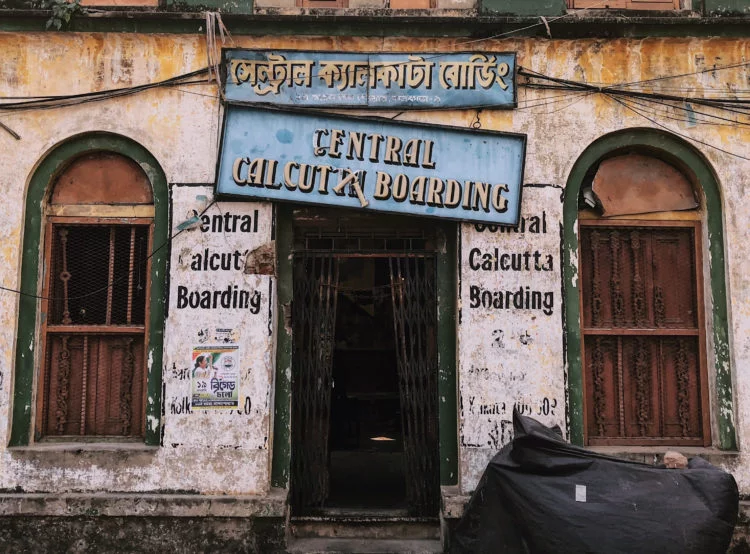
1. Metropolitan Institution, Burrabazar: The College That Powered the Bengal Renaissance
Founded in 1859-60 under the guidance of reformer Ishwar Chandra Vidyasagar, the Metropolitan Institution began life as a school before growing into a full college in 1872. It stands on Sankar Ghosh Lane in the Simla-Machuabazar pocket bordering Burrabazar and College Street, and today it operates as Vidyasagar College, renamed in 1917 in honour of its founder. The building itself is a modest, colonnaded 19th century structure rather than a palace, its significance lies almost entirely in what happened inside it.
Why it’s heritage, and a fact worth knowing: This was the first college in India run, financed, and managed entirely by Indians rather than a European body or missionary trust, making it a physical landmark of the Bengal Renaissance’s push for self-reliant education. The detail most visitors don’t expect: Swami Vivekananda studied here as a schoolboy, years before the institution was even upgraded to a college, and later alumni included scientist Acharya Prafulla Chandra Ray and historian Jadunath Sarkar.
When and How to Visit
It’s a working college, not a museum, so there are no visitor tickets or fixed sightseeing hours. The heritage facade and main gate are visible from Sankar Ghosh Lane during college hours on weekdays.
Nearest Metro: Central or Mahatma Gandhi Road, both a short walk away through the College Street book market.
Insider Tip
Combine this stop with a browse through the College Street book stalls right next door, and if you want to step inside, write ahead to the college office rather than showing up expecting a walk-in tour.
Good to Know
This is an active academic campus with students and staff on site, keep to the exterior and be mindful of class hours.
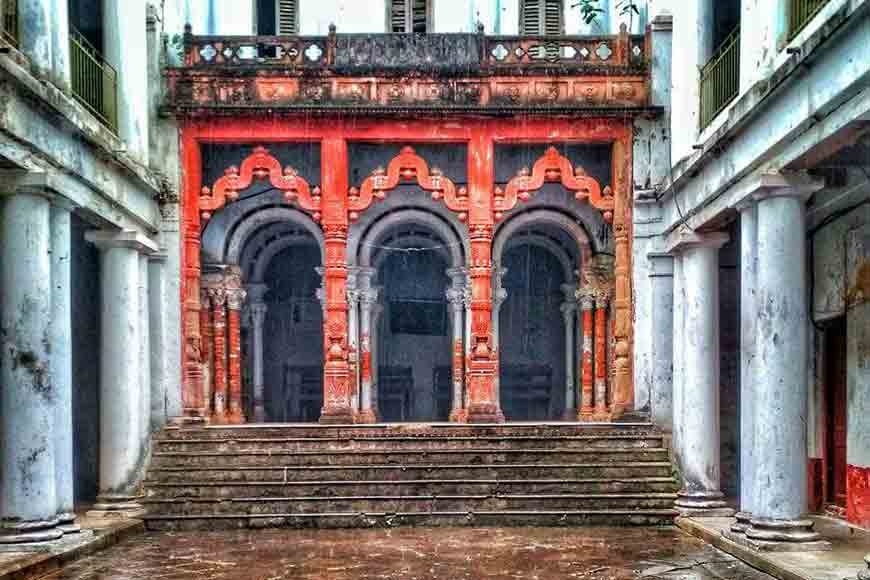
2. Pathuriaghata Ghosh Bari: North Kolkata’s Longest Marble Corridor
The Pathuriaghata Ghosh Bari is known for an 85 foot marble Thakur Dalan, the longest in Kolkata, built by Babu Khelat Chandra Ghosh, a clerk in the office of Governor General Warren Hastings. The mansion still functions as a residence and office for the Ghosh family. Address: 47 Pathuriaghata Street, Kolkata 700006.
Why it’s heritage, and a fact worth knowing: The house is a rare surviving example of a full scale bonedi bari built with wealth from serving the East India Company rather than from zamindari land holdings. During Durga Puja, the family bathes the idol in water gathered from thirteen rivers of Bengal, a ritual unique to this household and one that isn’t performed anywhere else in the city.
When and How to Visit
Closed to outside visitors for most of the year. The best chance of seeing the marble corridor and idol up close is during Durga Puja week. Nearest Metro: Girish Park.
Insider Tip
Pair this with the Metropolitan Institution and Armenian Church on the same North Kolkata loop, all three sit within easy reach of the Central and MG Road metro stops.
Good to Know
This is a lived in family home, not a monument. Keep visits respectful and brief outside Puja week.
3. Armenian Church of the Holy Nazareth: Kolkata’s Oldest Surviving Church
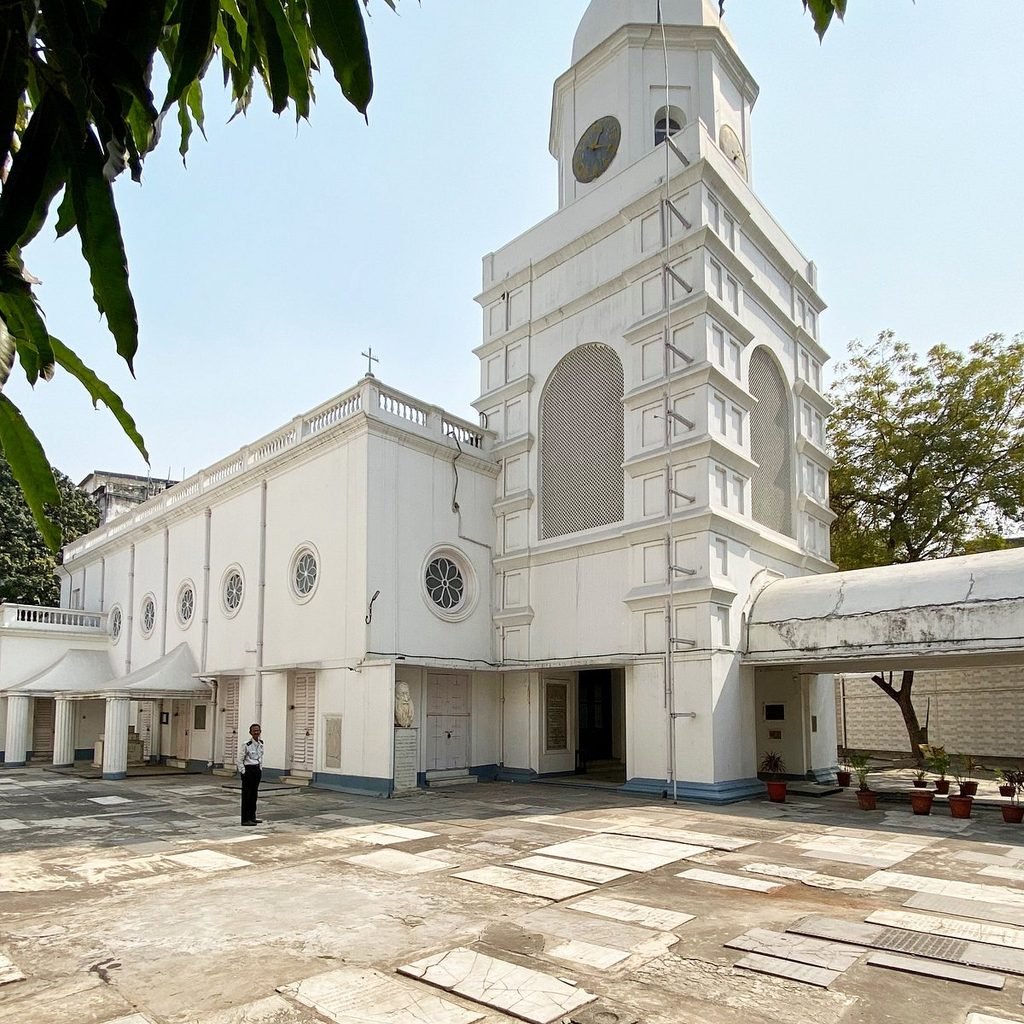
Hidden inside the bustling wholesale lanes of Burrabazar, this is believed to be the oldest church still standing in Kolkata. It was built around 1724 on the site of an older Armenian cemetery, funded through an agreement the Armenian community signed with the East India Company decades earlier. Inside, faded frescoes and marble memorial tablets record names of Armenian traders who settled in Bengal in the 17th and 18th centuries.
Why it’s heritage, and a fact worth knowing: This community shaped Kolkata’s earliest trade routes before the British consolidated power in Bengal, which makes the church older than most of the city’s colonial landmarks put together. The small Armenian community it still serves is one of the last active links to that pre-British trading history.
When and How to Visit
Still used by Kolkata’s remaining Armenian community, so visiting hours are informal daytime hours.
Nearest Metro: Mahatma Gandhi Road, a short walk into the Burrabazar wholesale lanes.
Insider Tip
If the gate looks closed, ask a shopkeeper nearby rather than assuming it’s shut for good, someone on the premises is usually reachable.
Good to Know
It’s an active place of worship, dress modestly and keep voices low inside. Worth combining with a walk through Burrabazar’s spice and hardware markets for contrast.
4. The Currency Building (Ghare Baire), BBD Bagh: Where the Reserve Bank of India Began
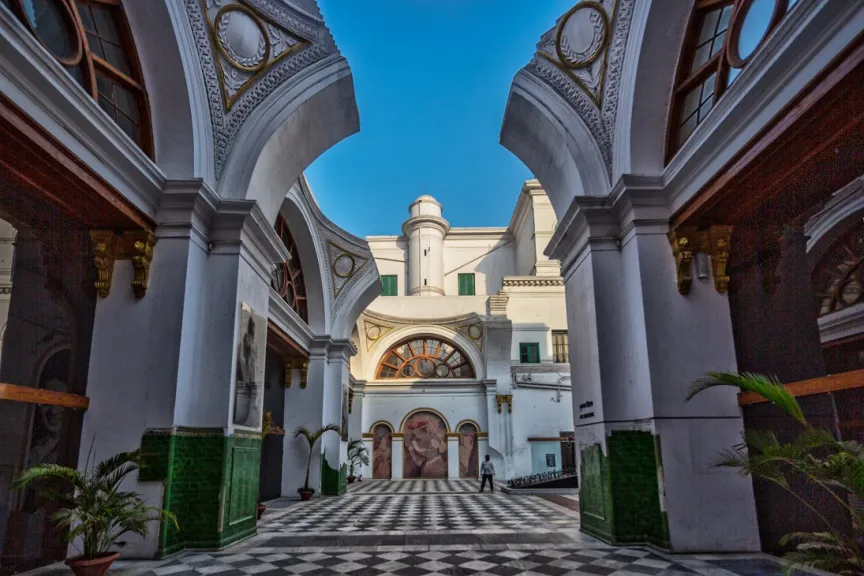
Most people rush past this Italianate building in BBD Bagh, not realising it once served as the first central office of the Reserve Bank of India, and before that, the Calcutta branch of the Agra Bank. Built in 1833, it is a three storey structure that traces the evolution of India’s financial history. The Archaeological Survey of India has restored it into a heritage museum and art gallery known as Ghare Baire, with marble floors, Venetian windows, and an underground canal once connected to the Hooghly River to help cool freshly minted coins.
Why it’s heritage, and a fact worth knowing: It is one of the few buildings in India where you can trace the entire arc from a private colonial bank to the birth of the country’s central banking system under one roof. The cooling canal beneath the building is rarely mentioned in guidebooks and is the kind of detail that makes a second visit worthwhile.
When and How to Visit
Entry is free.
Nearest Metro: Mahakaran (Green Line), under 5 minutes on foot toward BBD Bagh. Closed on Mondays like most ASI run sites in the city.
Insider Tip
Exhibitions rotate, so check the ASI Kolkata circle’s social pages before you head over to see what’s actually on display that month.
Good to Know
This is the first of four heritage stops within a 10 minute walk of Mahakaran Metro, pair it with Town Hall, Writers’ Building, and St. John’s Church below.
5. Calcutta Town Hall: A Lottery-Funded Museum of the City’s Own History
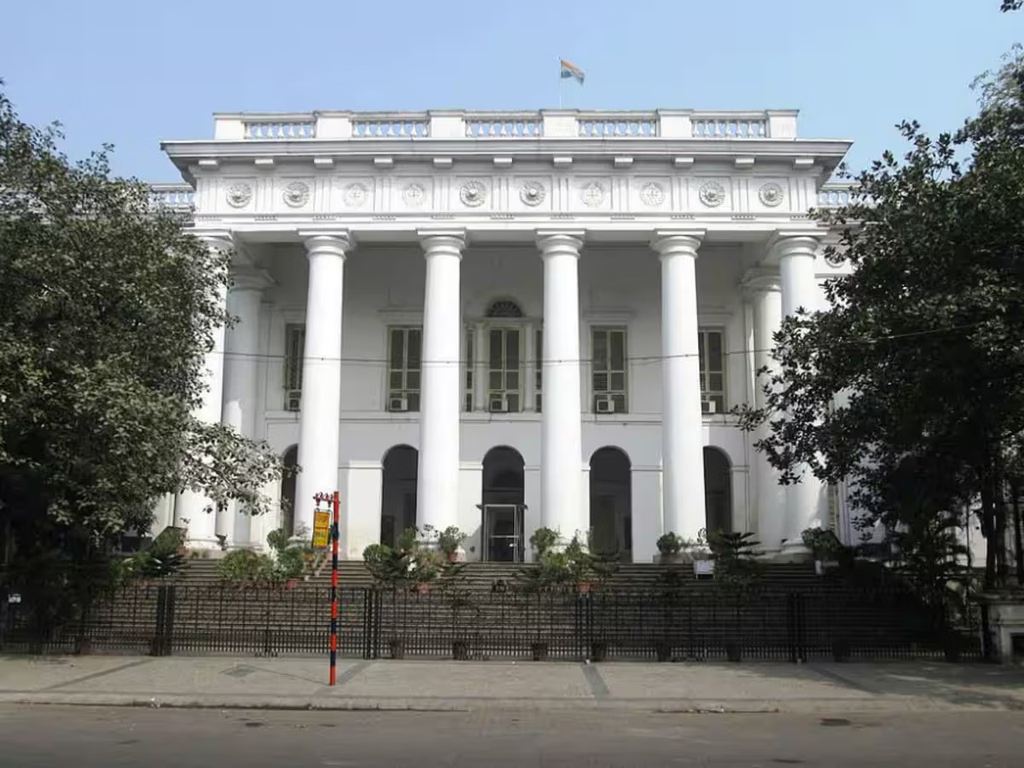
Facing the Kolkata High Court on Esplanade Row West, Town Hall was built in 1813 by architect and engineer Major General John Garstin in the Doric style, funded by 700,000 rupees raised through a public lottery. It originally served as a venue for European social gatherings in colonial Calcutta. Today it houses a museum with roughly nineteen galleries tracing the city’s social, political, and cultural history through dioramas, animated displays, and a research library built around the personal collection of Kolkata historian P. T. Nair.
Why it’s heritage, and a fact worth knowing: Town Hall is unusual for being a heritage building that tells Kolkata’s own story rather than a foreign or royal one, most of the exhibits inside focus on the city’s freedom movement and civic life. Few visitors realise the reference library inside holds original volumes like the diary of William Hedges, one of the earliest surviving English accounts of life in Bengal.
When and How to Visit
Open 10 AM to 5 PM, Tuesday to Sunday, closed Mondays. Entry is Rs. 10 on weekdays (Tuesday to Friday) and Rs. 15 on weekends and holidays, Rs. 5 for school children.
Nearest Metro: Mahakaran, a short walk away.
Insider Tip
Visit on a weekday both for the lower ticket price and because the galleries and library reading room are noticeably quieter than on weekends.
Good to Know
Occasionally hosts government seminars and lectures, opening hours can shift on those days, so it’s worth confirming access if you’re planning around a specific time.
6. Writers’ Building: The Red-Brick Heart of Bengal’s Administration
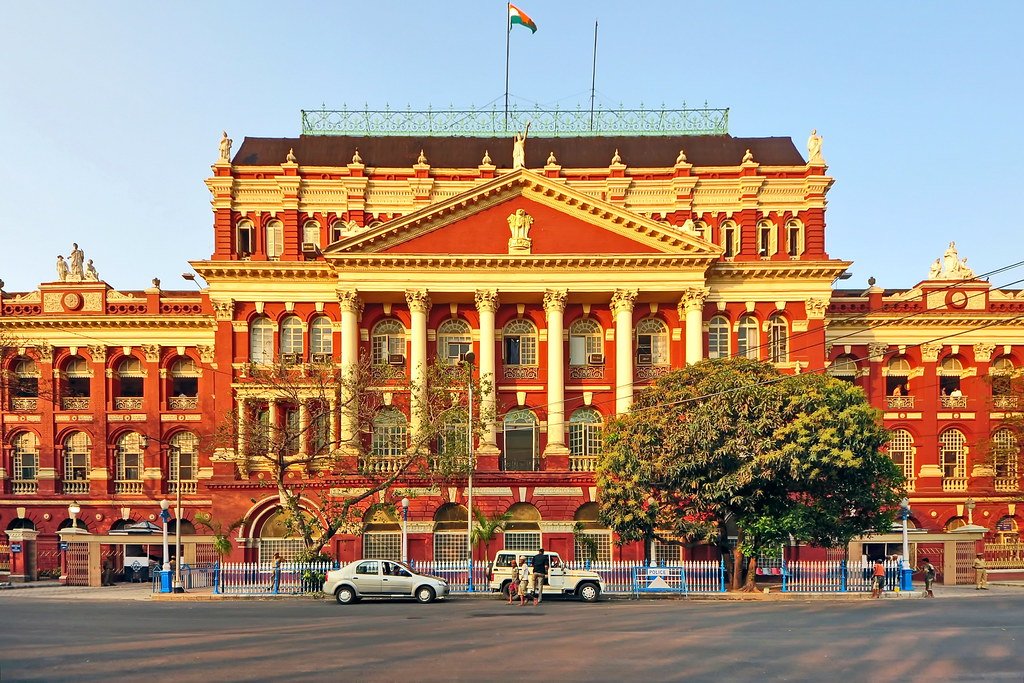
Overlooking Lal Dighi at the centre of BBD Bagh, Writers’ Building is a 150 metre long, neoclassical red brick complex designed by architect Thomas Lyon and completed in 1780. It was originally built to house junior clerks, called “writers”, of the British East India Company. Over nearly two and a half centuries it grew from a three storey structure into a sprawling 13 block complex covering over half a million square feet.
Why it’s heritage, and a fact worth knowing: Also known as Mahakaran, the building served as the seat of the Bengal and then West Bengal government for most of its history. It moved out to Nabanna in Howrah in 2013 for large scale restoration, and the state secretariat function returned to Writers’ Building in 2026, making it a rare heritage building that is still actively used for the exact administrative purpose it was built for.
When and How to Visit
The exterior can be viewed from BBD Bagh and Lal Dighi at any time, free of charge. Interior access is restricted to government officials and authorised visits, since it functions as a working government office.
Nearest Metro: Mahakaran, right at BBD Bagh.
Insider Tip
Stand across Lal Dighi tank for the best full length view of the facade, it’s the only spot that captures the entire 150 metre stretch in one frame, and late afternoon light works best for photos.
Good to Know
Being a working government building, security around the perimeter can be tighter than at the other BBD Bagh sites, keep photography to the exterior facade.
7. St. John’s Church: Job Charnock’s Resting Place
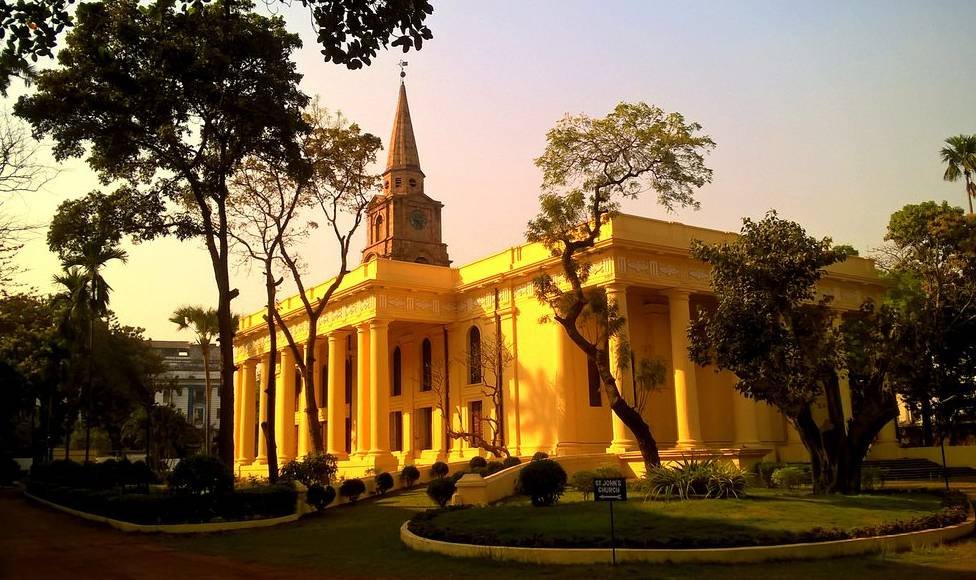
Known locally as Pathure Girja, or Stone Church, St. John’s was built between 1784 and 1787 on the site of an old, disused burial ground, using stone shipped down the Hooghly from the ruins of Gour. It served as Calcutta’s Anglican cathedral until St. Paul’s Cathedral took over that role in 1847. Architect James Agg designed it in the neoclassical style, with tall Doric columns and a graceful dome.
Why it’s heritage, and a fact worth knowing: The churchyard holds the octagonal mausoleum of Job Charnock, traditionally credited as the founder of Calcutta, along with the grave of Lady Canning and the Black Hole of Calcutta memorial. The land itself was donated by the zamindar Raja Nabakrishna Deb of Sovabazar, at the request of Warren Hastings. Rabindranath Tagore was also baptised here in 1865.
When and How to Visit
Open roughly 10 AM to 4 PM most days. Entry fee varries . Carry a nominal Rs. 10-20 as entry fee.
Nearest Metro: Mahakaran, a short walk from the North West corner of Raj Bhavan.
Insider Tip
Walk the churchyard before heading inside, Job Charnock’s mausoleum and the Black Hole memorial are easy to miss if you go straight for the main building.
Good to Know
This is an active place of worship with a Sunday service, dress modestly and keep quiet inside, especially on Sunday mornings
8. Indian Museum: The Oldest & Largest Museum in Asia
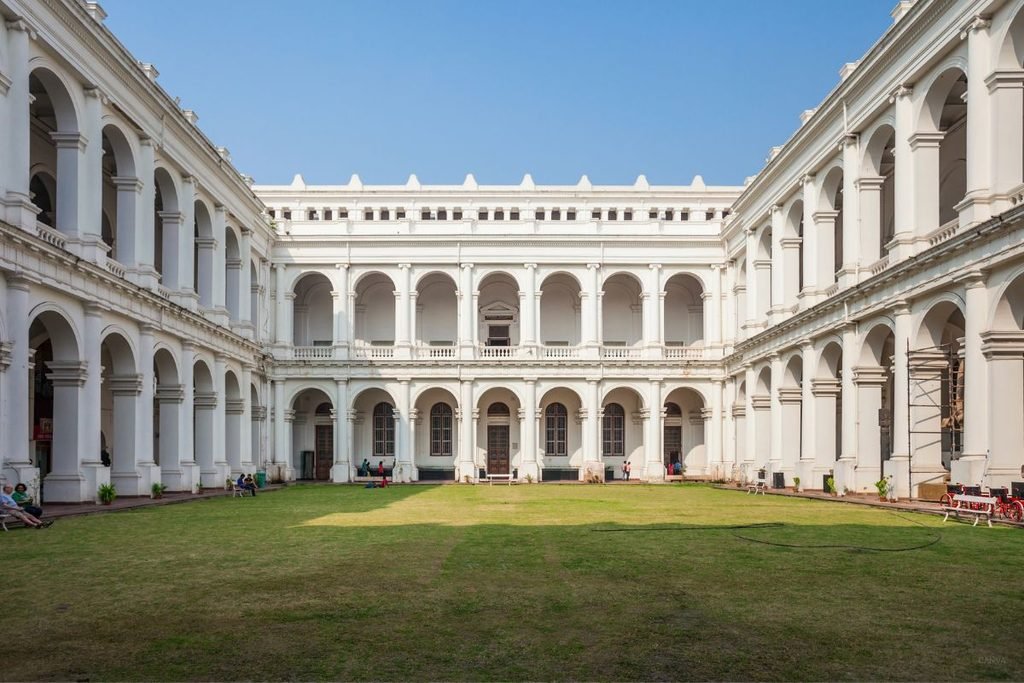
Founded in 1814 by the Asiatic Society of Bengal, with Danish botanist Nathaniel Wallich as its founding curator, the Indian Museum moved into its current Italian style building on Jawaharlal Nehru Road in 1878, designed by architect Walter B. Granville. It is the largest museum in India and the ninth oldest in the world, spread across three floors and nine galleries covering archaeology, art, anthropology, geology, and zoology.
Why it’s heritage, and a fact worth knowing: The building predates almost every other museum in the country and still holds artefacts that are effectively irreplaceable, including original railings from the 2nd century BCE Bharhut Stupa and Ashokan era pillar fragments. The detail that surprises most visitors: tucked among the dinosaur fossils and Mughal miniatures is a genuine ancient Egyptian mummy, one of only a handful on public display anywhere in South Asia.
When and How to Visit
Open 10 AM to 6 PM, Tuesday to Sunday, closed Mondays and major national holidays. Entry is Rs. 75 for Indian adults, Rs. 20 for visitors under 18, and Rs. 500 for foreign nationals.
Nearest Metro: Park Street, about a 5 to 10 minute walk.
Insider Tip
Go right at opening time, the mummy and dinosaur fossil galleries get genuinely crowded by midday, especially on weekends and school holidays.
Good to Know
Carry a student ID for discounted entry wherever applicable, and check gallery signage for photography restrictions, some sections don’t allow it.
9. South Park Street Cemetery: A Sculpture Garden of Colonial Calcutta
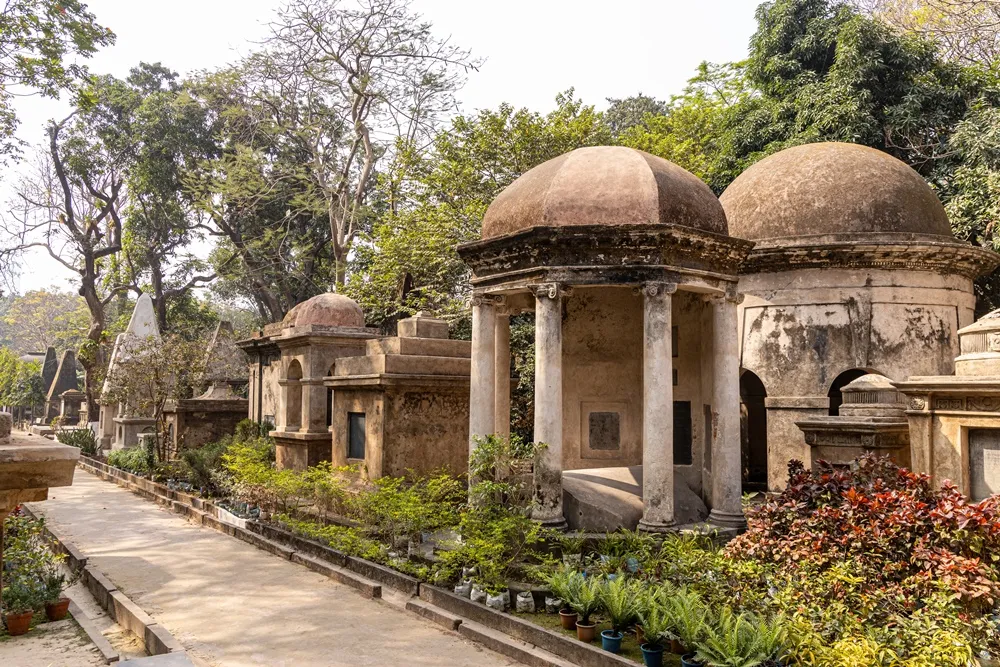
Opened in 1767 in what was then a swampy area, South Park Street Cemetery is one of the oldest non-church cemeteries in the world and remained active until around 1830. It is protected today by the Archaeological Survey of India. Walk its shaded paths and you will find Gothic obelisks, pyramid tombs, and one unusual “panchayatana” brick structure with a central dome flanked by miniature Odishan temple spires.
Why it’s heritage, and a fact worth knowing: The scale and variety of tomb architecture here, borrowed from Gothic, Egyptian, and even Indian temple styles, make it a one of a kind record of how colonial Calcutta’s elite tried to memorialise themselves. Many of the tombs mark early deaths from tropical disease, a quiet reminder of how dangerous 18th century Calcutta was for European settlers.
When and How to Visit
Visit between 10 AM and 4 PM to have enough daylight to read the older, weathered epitaphs. Reported entry rules vary by source, some list it as free, others mention a nominal fee for general entry and a separate camera charge. Nearest Metro: Park Street, a short walk from the exit.
Insider Tip
Wear closed shoes, the gravel and uneven ground between tombs is rough on sandals, and shade is limited in the middle of the day.
Good to Know
Carry small change for a possible general fee and separate camera charge, and confirm at the gate on arrival.
10. Bow Barracks and the Panioty Fountain: Kolkata’s Anglo-Indian Time Capsule
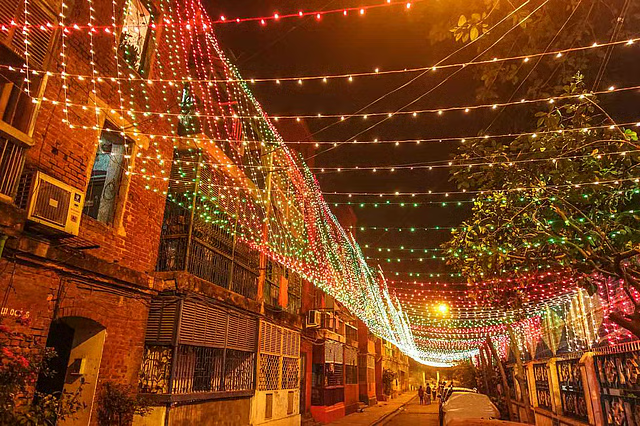
In the Anglo-Indian neighbourhood of Bow Barracks stands a historic drinking fountain built in 1895 by Lord Curzon in memory of a Greek resident of Kolkata named Demetrius Panioty. The fountain sits between the neighbourhood’s rust red barrack buildings, which still house one of Kolkata’s oldest Anglo-Indian communities.
Why it’s heritage, and a fact worth knowing: Bow Barracks is one of the last intact Anglo-Indian residential enclaves left in the city, and its architecture and community life offer a living contrast to the grander colonial buildings elsewhere on this list. Every December, the neighbourhood comes alive with home style Christmas baking sold straight from residents’ kitchens, a tradition that predates most of the city’s commercial bakeries.
When and How to Visit
An open residential area, free to walk through.
Nearest Metro: Esplanade, a short walk away, making it an easy final stop after Park Street.
Insider Tip
Visit in December during Christmas if you can . Residents sell home-baked cakes and wine straight from their kitchens, and the neighbourhood takes on a completely different, festive character.
Good to Know
This is a lived in residential neighbourhood, be respectful with cameras and keep to common areas.
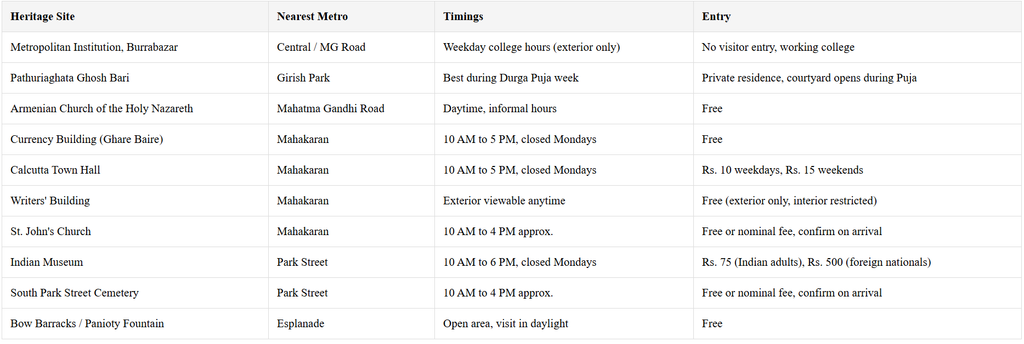
Quick Reference: Heritage Buildings in Kolkata
Frequently Asked Questions
Can I visit the Metropolitan Institution in Burrabazar?
It’s a working college today, known as Vidyasagar College, so there’s no ticketed visitor entry. You can see the heritage facade from Sankar Ghosh Lane during weekday college hours, and stepping inside generally requires prior permission from the college office rather than a walk-in tour.
Which metro station is closest to North Kolkata and Burrabazar’s heritage sites?
Central and Mahatma Gandhi Road metro stations are the most useful pair, covering the Metropolitan Institution, Pathuriaghata Ghosh Bari (via Girish Park), and the Armenian Church of the Holy Nazareth within a short walk or ride of each other.
Can I go inside Writers’ Building in Kolkata?
Not currently. Writers’ Building functions as a working government office and the state secretariat, so interior access is restricted to officials and authorised visits. You can view and photograph the full 150 metre red brick facade from BBD Bagh and across Lal Dighi at any time, free of charge.
How much does it cost to visit the Indian Museum in Kolkata?
Entry is Rs. 75 for Indian adults, Rs. 20 for visitors under 18, and Rs. 500 for foreign nationals. It’s open 10 AM to 6 PM, Tuesday to Sunday, and closed on Mondays and major national holidays.
How much time do I need for a heritage buildings tour in Kolkata?
Plan on two half days and one full day.
The first day North Kolkata and Burrabazar loop : Metropolitan Institution, Pathuriaghata Ghosh Bari, and the Armenian Church, takes about 3 to 4 hours. Nearest Metro : MG Road/Girish Park
The second day loop around BBD Bagh and Esplanade : Currency Building, Town Hall, Writers’ Building, St. John’s Church around Mahakaran metro & Bow Barracks near Esplanade .
The third day : Indian Museum and South Park Street Cemetery ; both near Park Street metro.
Want More of Kolkata’s Hidden Corners?
Explore more unexplored spots, from the city on Explore Kolkata.