
Long before Delhi became the capital of independent India, Kolkata was the capital the British feared most. As the seat of British India for nearly 140 years, Calcutta was where the empire made its money, and it became the city where that empire first heard “no” said back to it in a voice loud enough to matter. Bengal gave India its first defiant flag in 1906, its national anthem in 1911, and the very words of “Vande Mataram” decades before that. It gave the freedom movement its first mass boycott, its most feared revolutionary networks, and Netaji Subhas Chandra Bose. This is the story of how one city and one province did not just participate in India’s freedom struggle. They lit the fuse.
In This Article
- Why Kolkata Was Ground Zero: The Capital of British India
- The Partition of Bengal (1905): The Spark That Started It All
- The Swadeshi Movement: India’s First Mass Uprising
- Fact File: The First Indian Flag Was Hoisted in Kolkata
- Fact File: India’s National Anthem Was First Sung in Kolkata
- Fact File: Bengal Wrote India’s National Song, Decades Before Independence
- The Revolutionaries: Anushilan Samiti, Jugantar, and the Alipore Bomb Case
- Why the British Moved Their Capital Away From Kolkata
- Netaji Subhas Chandra Bose and the Indian National Army
- Bengal’s Legacy: What It Means to Walk These Streets Today
- Quick Reference: Bengal’s Freedom Struggle Firsts
- Frequently Asked Questions
Why Kolkata Was Ground Zero: The Capital of British India
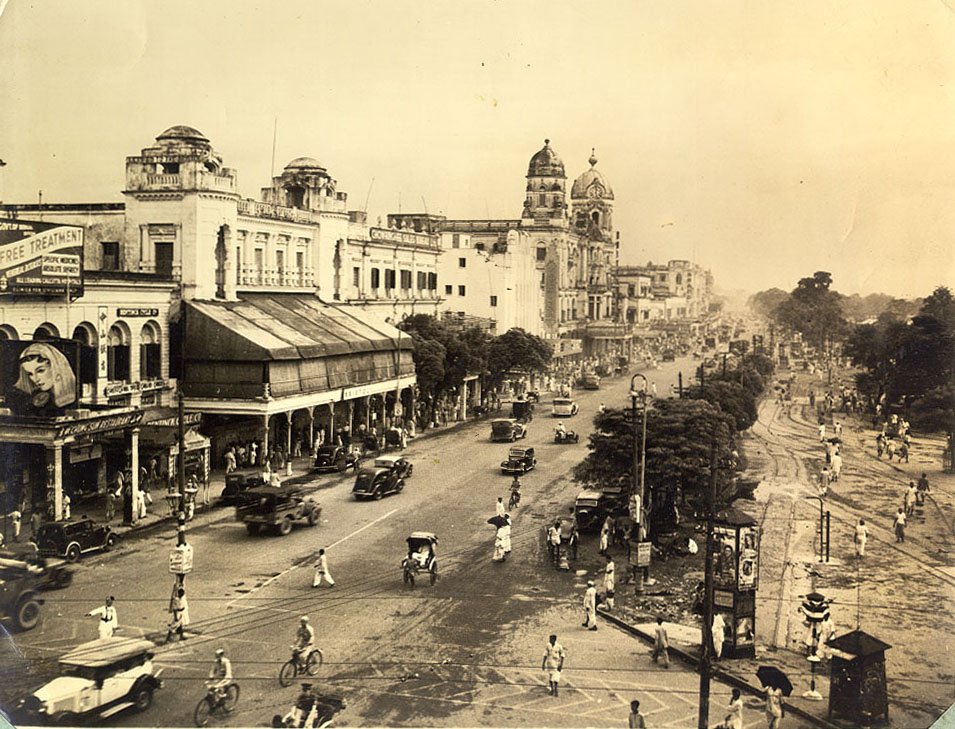
If you have ever wondered why so many of India’s freedom struggle’s biggest moments trace back to the lanes of Kolkata, the answer starts with geography and power. Calcutta was the capital of British India from 1772, under the East India Company, all the way to 1911, when the British Crown administered the country directly. For nearly a century and a half, every major decision about India was made, or at least approved, in Calcutta. Every telegram to London, every policy on land revenue, every crackdown on dissent, it all passed through this city.
That concentration of British power had an unintended consequence. It also concentrated the fight against it. Calcutta had the presses that printed nationalist newspapers, the courts where political trials became public spectacles, the colleges that produced a generation of English-educated Bengalis who could read Mill and Locke and then turn those very ideas of liberty against their rulers, and the streets where the first mass rallies against colonial policy were held. When you are the administrative heart of an empire, you are also, inevitably, its most exposed nerve.
The Partition of Bengal (1905): The Spark That Started It All
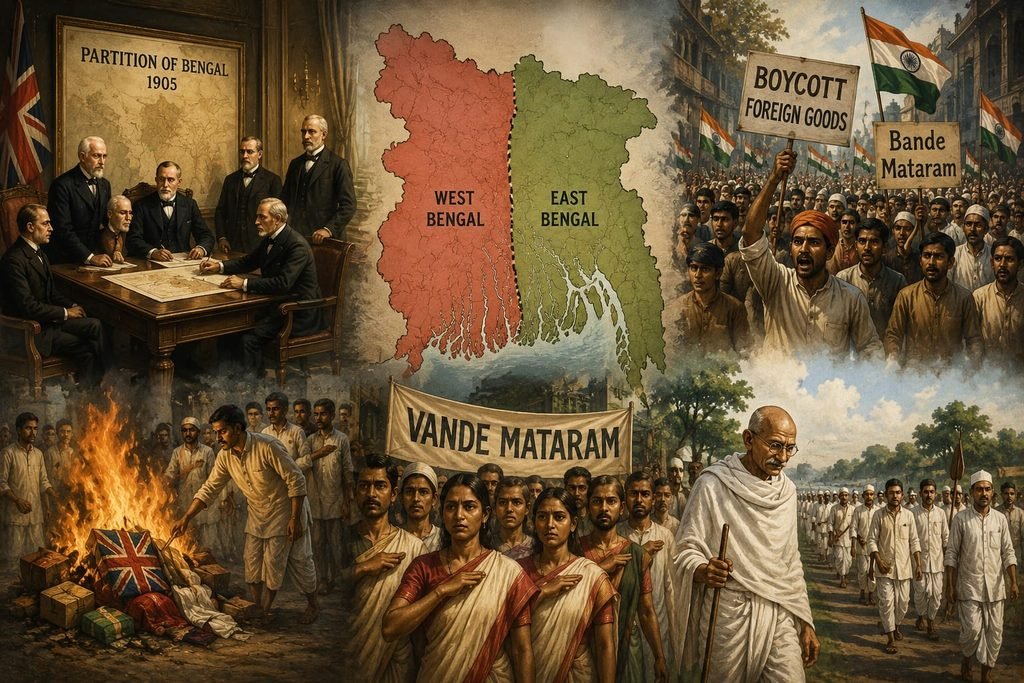
On 16 October 1905, Viceroy Lord Curzon split the province of Bengal into two, officially citing administrative convenience. Nobody in Bengal believed that for a second. The province was, at the time, home to a large and increasingly assertive educated middle class, and the partition was widely read as a deliberate British attempt to break Bengali unity along religious lines and cripple the province that had become the intellectual capital of Indian nationalism.
It backfired completely. Instead of dividing Bengalis, the partition united them like nothing before it. Hindus and Muslims, students and shopkeepers, poets and lawyers, all found common cause in opposing it. The protests that followed did not stay confined to petitions and newspaper editorials. They turned into the first genuinely mass movement of the Indian freedom struggle, and it started right here, in Calcutta’s streets and Town Halls.
The British eventually reversed the partition in 1911, a rare and humiliating climbdown for the colonial government. But by then, the movement it had triggered had already changed the character of Indian nationalism forever.
The Swadeshi Movement: India’s First Mass Uprising
The Swadeshi Movement was formally launched from Calcutta’s Town Hall on 7 August 1905, directly in response to the Bengal partition. Swadeshi, meaning “of one’s own country,” called for two things at once: boycotting British goods and institutions, and actively building Indian alternatives to replace them.
This was not symbolic protest. It was an economic and cultural rebellion with real teeth:
- Boycott of British cloth and goods, which hit Manchester’s textile exports to India hard enough that it became a talking point in the British Parliament.
- Growth of indigenous industry, including the founding of Bengal Chemicals and a wave of swadeshi soap, match, and textile enterprises, alongside the National Council of Education and institutions like the Bengal National College under Aurobindo Ghosh.
- A new form of protest called Rakhi Bandhan, where Bengalis of different religions tied sacred threads on each other’s wrists as a symbol of unity against a partition designed to split them apart.
Mahatma Gandhi himself would later credit the Swadeshi Movement as “the soul of Swaraj,” the philosophical seed of the self-reliance and non-cooperation strategy he would go on to use nationwide. Bengal did not just protest the British. It handed the rest of India its playbook.
Fact File: The First Indian Flag Was Hoisted in Kolkata
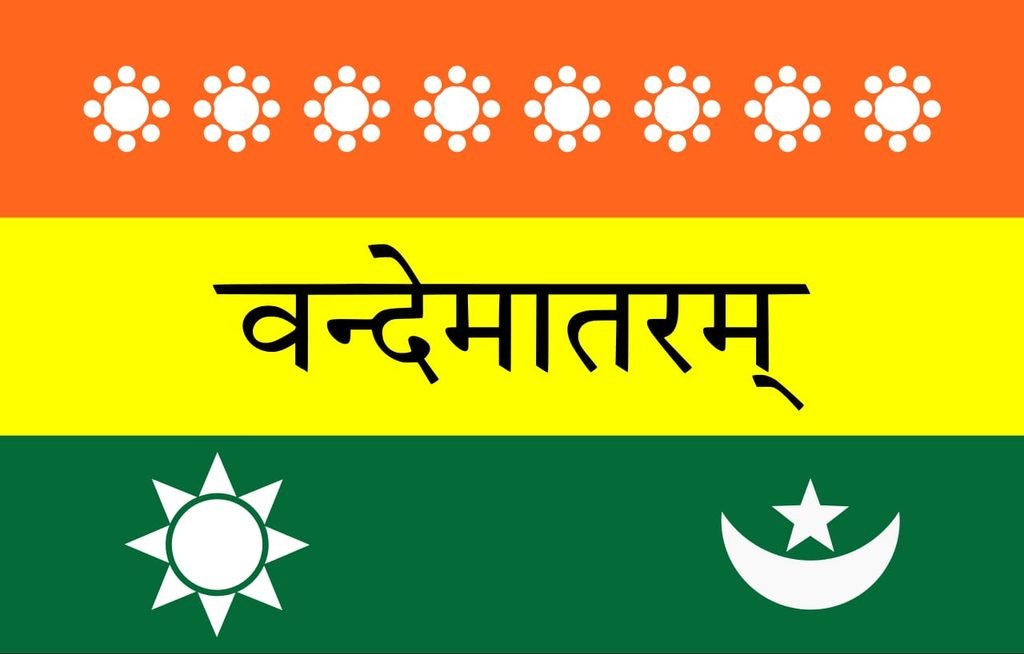
Here is a fact that surprises even a lot of well-read Indians. The first version of what would eventually evolve into India’s tricolour was hoisted not in Delhi, not at the Red Fort, but at Parsee Bagan Square, known today as Greer Park, in Calcutta, on 7 August 1906, exactly one year after the Swadeshi Movement began.
Known as the “Calcutta Flag,” it was designed by Sachindra Prasad Bose and Hemchandra Kanungo (some accounts also credit Sukumar Mitra), and it was hoisted by Surendranath Banerjee at a massive protest meeting held as a “Boycott Day” against the Bengal partition. The flag had three horizontal stripes of red, yellow, and green, with the words “Vande Mataram” written across the middle band, a sun and crescent moon on the red stripe, and eight half-open lotuses on the green stripe, believed to represent the eight provinces of British India.
This was not the official national flag India adopted in 1947, but it was the first attempt at a unifying Indian national symbol, and it directly inspired the “flag of Indian independence” that revolutionary Bhikaiji Cama, herself born in Calcutta into a Parsi family, unfurled at the International Socialist Congress in Stuttgart, Germany, in 1907, carrying Bengal’s defiance onto a world stage for the first time.
Fact File: India’s National Anthem Was First Sung in Kolkata
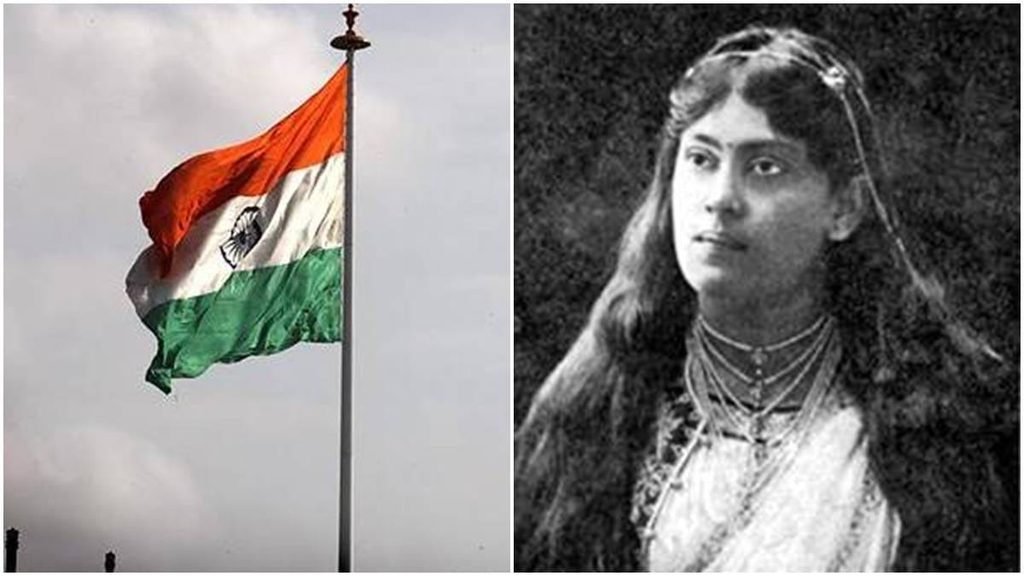
India’s national anthem, “Jana Gana Mana,” was first sung in public on 27 December 1911, at the Calcutta Session of the Indian National Congress. It was performed by Sarala Devi Chowdhurani, Rabindranath Tagore’s niece, along with a group of school students, in a modest building on Bowbazar Street in front of Congress leaders including then-president Bishan Narayan Dhar.
The song was written and composed just weeks earlier, on 11 December 1911, by Rabindranath Tagore, a Bengali polymath and the first Asian to win the Nobel Prize in Literature. It was originally titled “Bharoto Bhagyo Bidhata” and was written in Bengali, later translated into Hindi. It would take almost forty more years for the song to be formally adopted, which happened on 24 January 1950, but Kolkata is where India first heard the anthem that would one day open every school morning and every Republic Day parade in the country.
Fact File: Bengal Wrote India’s National Song, Decades Before Independence
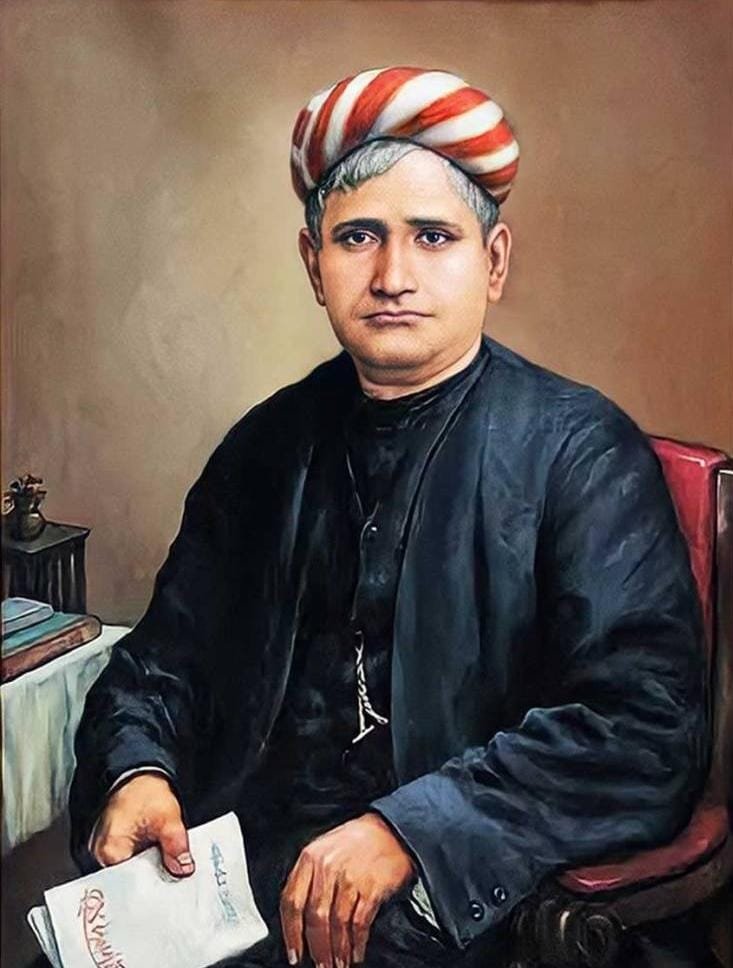
If the anthem came from Kolkata, the national song came from Bengal even earlier, and it is arguably the single most important literary weapon the freedom movement ever produced. “Vande Mataram” was written by Bengali novelist Bankim Chandra Chattopadhyay and published in his 1882 novel “Anandamath,” though he is believed to have composed the verses years before that, reportedly after witnessing a British officer humiliate an Indian in Berhampore, Bengal.
“Vande Mataram,” meaning “I bow to thee, Mother,” reimagined the Indian homeland itself as a mother goddess, and it turned devotion to the land into an act of open political defiance. It was set to music by Jadunath Bhattacharya, later popularised by Tagore himself, who sang it while leading revolutionary marches, and it was translated into English by Aurobindo Ghosh in 1909. By the time the Swadeshi Movement broke out, “Vande Mataram” had already become the rallying cry chanted at protests, printed on banners, and shouted by prisoners on their way to the gallows. It was formally adopted as India’s national song on 24 January 1950, the same day as the anthem, and India’s first president, Dr. Rajendra Prasad, declared it should be honoured equally.
Two of India’s most sacred national symbols. Both born from the pen and the voice of Bengal, decades before a single word of the Constitution was written.
The Revolutionaries: Anushilan Samiti, Jugantar, and the Alipore Bomb Case
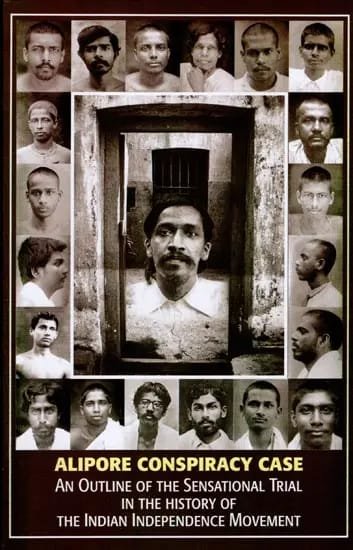
Not every chapter of Bengal’s fight for freedom was written in poetry and protest marches. A significant part of it was written in secrecy, in bomb-making workshops, and in courtrooms, and this is the part of the story that shows how far Bengal was willing to go.
Following the 1905 partition, secret revolutionary societies like the Anushilan Samiti and its offshoot Jugantar sprang up across Calcutta and East Bengal, training young men in physical fitness, firearms, and explosives, determined to overthrow British rule by force where petitions had failed. A British intelligence report of the time recorded roughly 210 revolutionary incidents and 101 attempts across Bengal between 1906 and 1917.
The most famous of these was the 1908 Muzaffarpur bombing, where Jugantar revolutionaries Khudiram Bose, just 18 years old, and Prafulla Chaki attempted to assassinate British magistrate Douglas Kingsford. The bomb missed its target and killed two British women instead. Khudiram Bose was hanged on 11 August 1908, becoming one of the youngest martyrs of the freedom struggle, while crowds reportedly lined the streets and showered his body with flowers. The fallout led directly to the Alipore Bomb Case, a landmark trial of Anushilan Samiti members held at the Alipore Sessions Court in Calcutta between 1908 and 1909, in which nationalist leader Aurobindo Ghosh was eventually acquitted but many of his associates were sentenced to death or transportation for life.
This was Bengal at its most uncompromising: a generation of young men and women willing to give their lives, not just their voices, for an idea most of the country had not yet dared to say out loud.
Why the British Moved Their Capital Away From Kolkata : The Fear of Bengal Among The Britishers
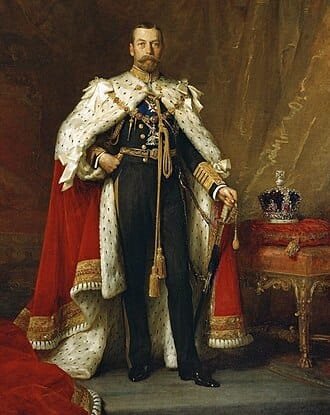
Here is a fact that says everything about how much the British feared Bengal. On 12 December 1911, at the Delhi Durbar, King George V announced that the capital of British India would move from Calcutta to Delhi. Officially, the reason given was administrative convenience and Delhi’s more central location. Unofficially, historians widely agree that Calcutta had simply become too politically dangerous to govern from. The city had become the epicentre of the Swadeshi Movement, home to the most active revolutionary networks in the country, and the British establishment wanted physical and political distance from the unrest it could no longer control.
Put simply: the British Empire uprooted its own capital of nearly 140 years and rebuilt an entirely new one from scratch in Delhi because Bengal’s fight for freedom had made Calcutta ungovernable. It is hard to find a stronger acknowledgment, from the colonisers themselves, of how central Kolkata was to shaking their grip on India.
Netaji Subhas Chandra Bose and the Indian National Army
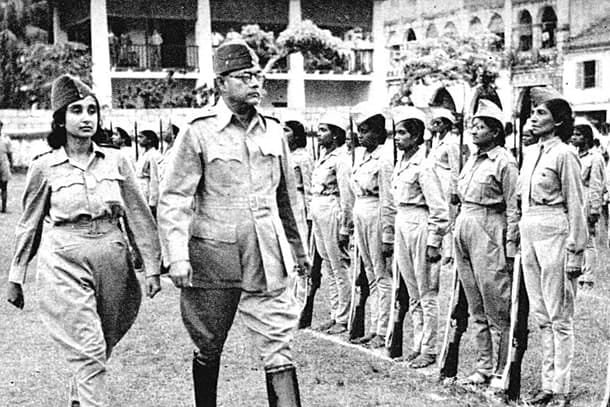
Bengal’s contribution to the freedom struggle did not end with the revolutionaries of the 1900s. It arguably reached its most dramatic chapter decades later, through Subhas Chandra Bose, born in Cuttack to a Bengali family and educated at the University of Calcutta, who would go on to be affectionately called Netaji, or “respected leader.”
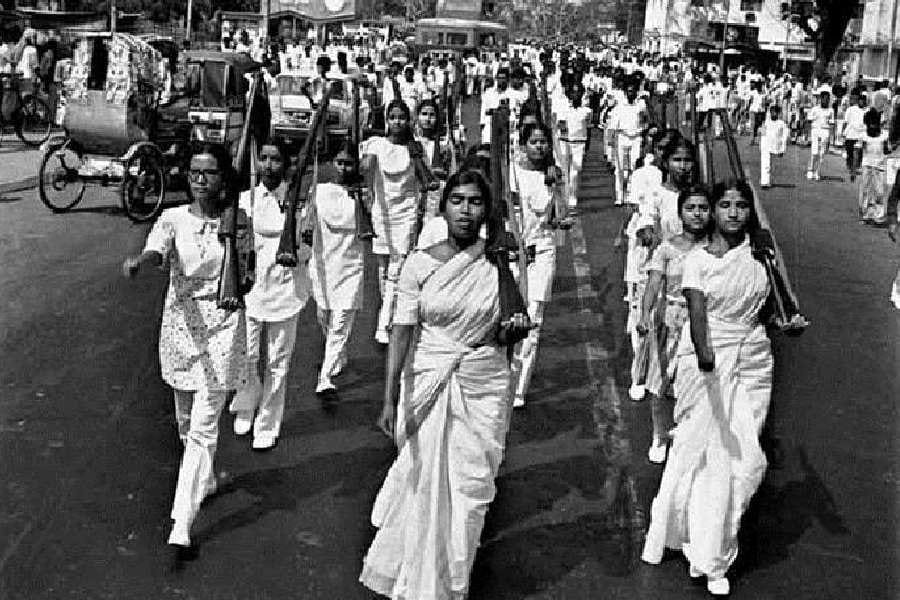
Bose served as President of the Indian National Congress in 1938 and 1939, and had earlier been the Mayor of Calcutta from 1930 to 1931. After breaking with Congress leadership over strategy, he went on to lead the Indian National Army (INA), or Azad Hind Fauj, from 1943 to 1945, raising an armed force, including the all-women Rani of Jhansi Regiment, that fought alongside Axis powers in a bid to liberate India by force. His rallying cry, “Give me blood, and I shall give you freedom,” remains one of the most quoted lines in Indian history. Bose died in a plane crash in Taiwan in August 1945, before he could see the freedom he fought so fiercely for, but the INA trials that followed in Delhi in 1945 and 1946 sparked mass protests and mutinies across India that historians consider among the final pressures that convinced Britain independence was no longer avoidable.
Bengal’s Legacy: What It Means to Walk These Streets Today
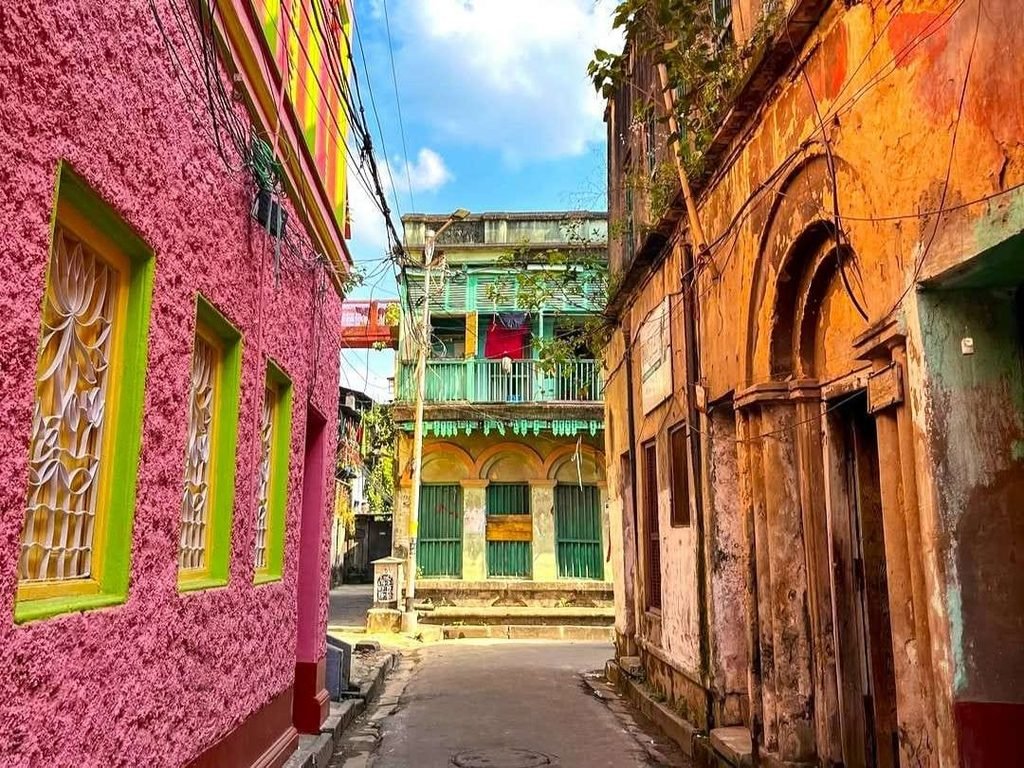
Walk through College Street today and you are walking through the same lanes where students once organised boycotts between classes. Stand at the site of Parsee Bagan Square, and you are standing where a group of ordinary Bengalis hoisted a flag that no empire had given them permission to make. Visit Alipore Jail, and you are inside walls that once held some of the bravest young men this country has ever produced, several of whom never walked out.
What makes Kolkata’s role in the freedom struggle so remarkable is not any single event. It is the sheer density of firsts packed into one city and one province: the first mass movement, the first national flag, the first national anthem performance, the birthplace of the national song, the most feared revolutionary networks, a Congress president who raised his own army, and finally, the humiliation of forcing an empire to abandon its own capital. No other single region of India carries quite that combination of cultural, political, and revolutionary firsts. That is not Bengali pride talking. That is simply what the historical record shows.
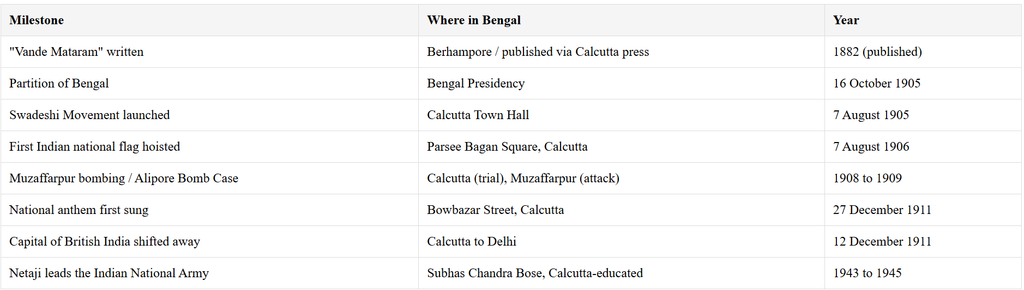
Quick Reference: Bengal’s Freedom Struggle Firsts
Frequently Asked Questions
Was the first Indian flag really hoisted in Kolkata?
Yes. The “Calcutta Flag,” widely regarded as the first unofficial national flag of India, was hoisted at Parsee Bagan Square in Calcutta on 7 August 1906, during a protest against the partition of Bengal. It later inspired the flag Bhikaiji Cama unfurled in Germany in 1907.
Where was India’s national anthem first sung?
India’s national anthem, “Jana Gana Mana,” was first sung in public at the Calcutta Session of the Indian National Congress on 27 December 1911, weeks after Rabindranath Tagore composed it.
Who wrote India’s national song, and was he Bengali?
Yes. “Vande Mataram,” India’s national song, was written by Bengali novelist Bankim Chandra Chattopadhyay and published in his 1882 novel “Anandamath.” It became one of the most powerful rallying cries of the entire freedom movement.
Why was Calcutta the capital of British India?
Calcutta became the capital under the East India Company in 1772 due to its strategic port location and trade importance, and it remained the capital of British India until 1911, when the British shifted the capital to Delhi.
Why did the British move their capital from Calcutta to Delhi?
Officially, the British cited administrative convenience and Delhi’s central location. Most historians agree the political unrest, revolutionary activity, and mass movements centred in Bengal after the 1905 partition made Calcutta increasingly difficult for the British to govern from.
What was the Swadeshi Movement and why did it start in Bengal?
The Swadeshi Movement was a boycott of British goods combined with the promotion of Indian-made products, launched from Calcutta’s Town Hall on 7 August 1905 in direct response to the partition of Bengal. It is considered the first organised mass movement of India’s independence struggle.
Who was Khudiram Bose?
Khudiram Bose was an 18-year-old Bengali revolutionary from the Jugantar group who attempted to assassinate a British magistrate in the 1908 Muzaffarpur bombing. He was executed on 11 August 1908, becoming one of the youngest martyrs of India’s freedom struggle.
Want to Know more of Kolkata’s
rich history ?
Follow Soul Of Kolkata for more such cultural and heritage contents.